
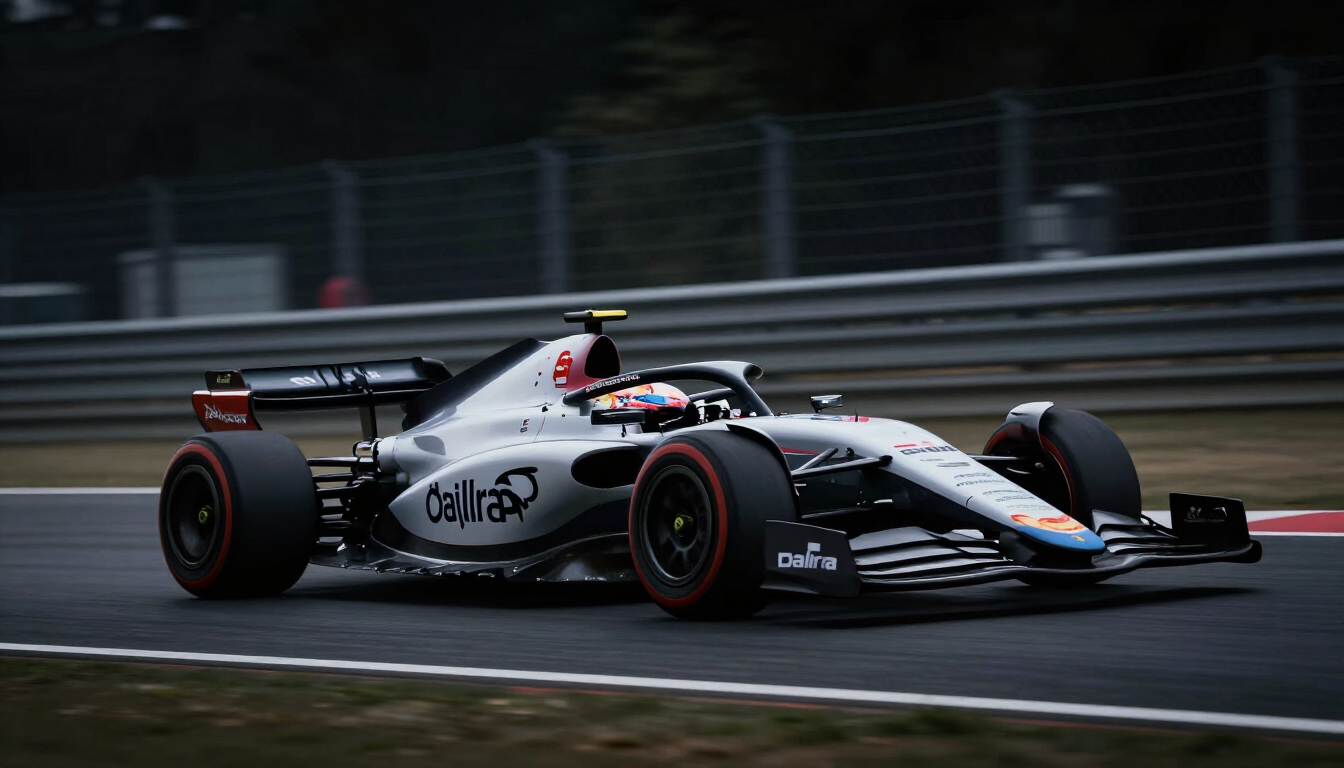
The driver in his second F2 season talks about what a realistic F1 programme costs, why simulator time changed his racecraft, and what the super licence threshold actually means.
The super licence point threshold is forty points, accumulated across a defined set of junior categories. In Formula 2, the point allocation means that a driver finishing the season in the top four is, in principle, eligible to apply. In practice, the eligibility conversation is different from the commercial conversation, and the driver we spoke to has learned to distinguish between them.
"I have the points to apply," he said. "That is the regulatory part. The commercial part is a separate conversation. No team is going to put a driver in an F1 car because he has forty super licence points. They need to know the driver, trust the engineer, and have confidence that the speed translates. That takes time, and it takes access, simulator time, test programmes, conversations that happen before any formal process begins."
The simulator access is the part of the process that most junior drivers describe as transformative. The level of simulation available to an F2 driver on a manufacturer programme is qualitatively different from what an independent driver can access. It is not just the hardware, it is the data overlay, the engineer alongside you, and the objective feedback on where the time is being lost. He described a two day F1 simulator programme that identified a braking pattern in his technique that had been costing him two tenths per lap for three seasons. "Two tenths," he said. "I did not even know it was there."
The budget question is the one that the sport is most uncomfortable discussing openly. The direct cost of a competitive F2 programme varies by team but the range published in financial disclosure documents and reconstructed from team principals' public statements runs from 1.8 to 3.2 million euros per season, excluding driver personal costs, management fees, and the indirect costs of the support programme. "Most drivers cannot pay that alone," he said. "Some have family support. Some have national programmes. Most have a management company that has put together a commercial package. I am in the third group. It works, but it does not work infinitely."
The pressure is real and it is specific. It is not the pressure of losing a race, that is racing, and it resolves on Sunday afternoon. It is the pressure of a commercial structure that requires results to justify renewal, a super licence threshold that is necessary but not sufficient, and a timeline that runs on seasons rather than years. "I have two, maybe three more seasons at this level before the conversation changes," he said. "I know what I need to do. The simulator told me."
The 2026 FIA Formula 2 Championship standings capture the state of play recorded After Round 9, Budapest. Nikola Tsolov leads the drivers classification on 167 points, 20 clear of Gabriele Minì on 147, with Rafael Câmara third on 145. A lead of 20 points is a meaningful cushion at this stage of the year, but with 5 rounds still to run it is not yet a decisive one. The championship will be settled by how the front runners negotiate the rounds that remain, not by the margin they carry into them.
Behind the leading group the field is tightly compressed. Alexander Dunne holds fourth on 108, Noel León is fifth on 94, and Kush Maini completes the top six on 88. The spread across those three positions is just 20 points, which means a single strong weekend can reshape the order behind the title contenders. The midfield battle is where the championship depth is most visible, and where the cost of one bad round is highest.
In the teams classification, Campos Racing leads on 261 points from Invicta Racing on 187 and MP Motorsport on 176. The teams standings are often the more reliable indicator of outright pace, because they smooth out the individual bad weekends that every driver encounters across a full season. A team that places both its entries consistently in the points will accumulate constructors score at a rate that single car brilliance cannot match.
The depth of the teams championship reflects how competitive the Formula 2 grid has become. Campos Racing holds the lead on 261 points, but the gap to Invicta Racing on 187 is small enough that a single double points finish can close it. Behind them, MP Motorsport sits third on 176, close enough to capitalise if either of the top two stumbles. The constructors race is a long game, and it rewards reliability over heroics.
The recent rounds have done most to shape the current standings. Silverstone at Silverstone, Great Britain was won by Bennett / Tsolov, Spa Francorchamps at Spa Francorchamps, Belgium went the way of Tsolov / León, and the most recent completed round, Budapest at Hungaroring, Hungary, was won by Maini / Câmara. Each of those results shifted the points arithmetic at the top and reset the momentum that the title contenders carry into the next weekend.
The form guide across the recent rounds reads as a study in momentum. Maini / Câmara took the most recent victory at Hungaroring, Hungary, Tsolov / León won at Spa Francorchamps, Belgium before that, and Bennett / Tsolov prevailed at Silverstone, Great Britain. No single driver has dominated the recent sequence, which is why the points lead at the top has remained stable rather than stretching. The closing rounds will decide whether that pattern holds or one contender finally strings together the run of results that settles the title.
The next round is Monza at Autodromo di Monza, Italy, scheduled for 3, 5 Sep. It is round 10 of the season and the first of the closing stretch. How the championship leader handles the specific technical demands of Autodromo di Monza, Italy will indicate whether the current margin is a foundation to build on or a high water mark that the chasing group can erode. Every remaining weekend now carries championship weight.
The 2026 FIA Formula 2 Championship calendar runs to 14 rounds. So far 9 rounds are complete, leaving 5 to decide the title. Across the completed rounds the championship has tested its contenders on a range of layouts, surfaces and conditions, and the standings reflect which driver has coped with that variety most consistently. The rounds still to come will ask different questions, and the answers will determine the champion.