
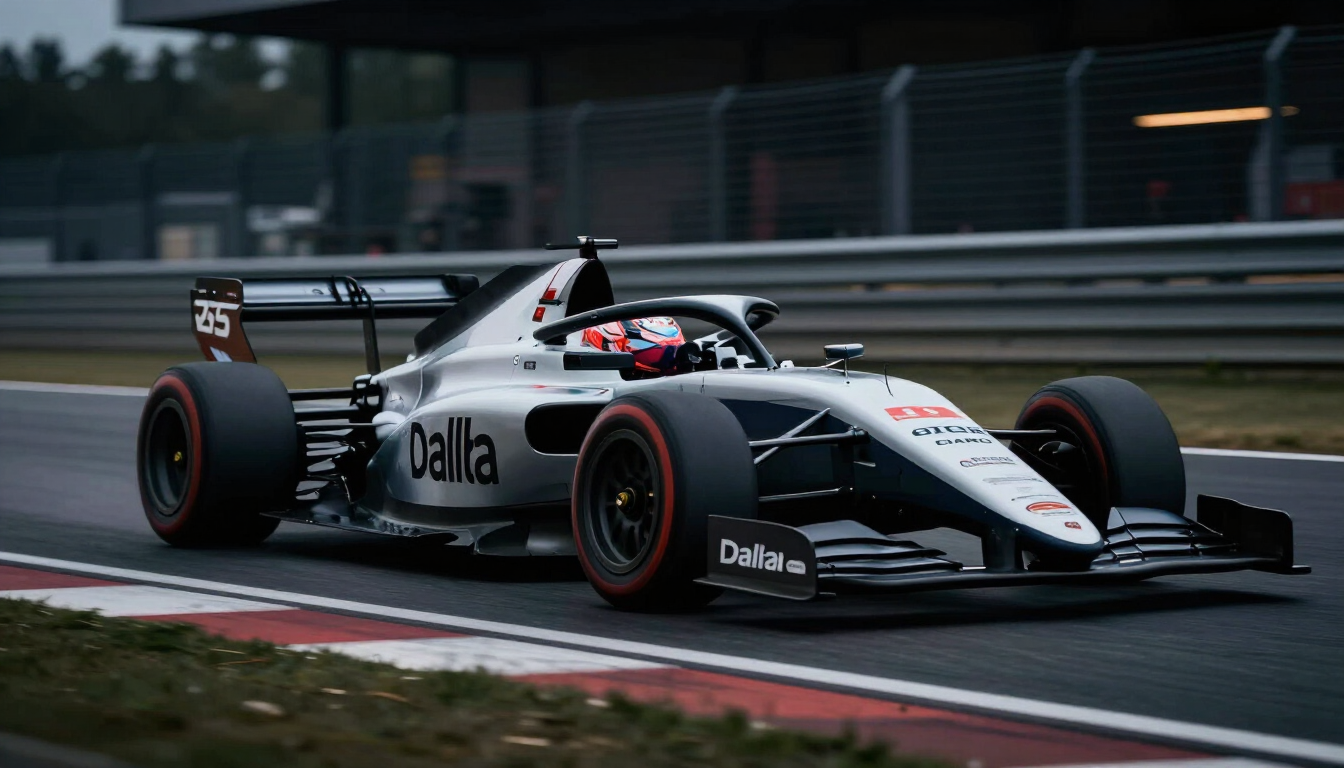
The driver who made the jump from F3 to F2 in three months describes what the data showed, what the simulator revealed, and what he was not expecting.
The call came in October. He had finished third in the F3 championship, scored four wins, and been consistently in the top three in qualifying. The team had an F2 seat available after their contracted driver moved to a manufacturer GT programme. They wanted him to test in November, evaluate in December, and sign in January. The whole process from first conversation to contract took eleven weeks.
"The F2 car is physically different in a way the simulator does not fully prepare you for," he said. "The mass is about thirty percent higher than the F3 car. The tyre size is bigger. The downforce is significantly more. But the biggest difference is the mechanical feedback, the way the car communicates what is happening at the tyre contact patch. In F3, the car is quite communicative. The F2 car is less so. You have to read it differently."
The simulator programme that the team ran across December focussed on four circuits: the opener, two mid season circuits he had not raced at, and Monaco. The simulator time was approximately forty hours across the six weeks. He described it as valuable but limited, the feedback quality was lower than in F3 simulator work, because the F2 car's characteristics in the simulator model had not been fully validated against the specific driving style he would bring to it. "They knew the car. They did not yet know me driving the car. The first test was more diagnostic for the team than for me."
The first live test session was in January, at a cold European circuit that offered limited tyre temperature. He was four tenths off the pace in the morning. After lunch, the team made three setup changes based on the data from the morning: a small rear wing trim, a differential adjustment, and a brake bias shift that moved more load to the front. He went a tenth and a half faster in the first run of the afternoon. By the final run of the day, he was on the pace of the fastest times from the session.
"Four tenths to on the pace in one afternoon does not mean I am ready," he said. "It means the car and I found each other. That is the first step. The second step is finding each other consistently, across different conditions, different circuits, different tyre states. That takes the full first season. I know I am in the right place. I just have to keep working."
The 2026 FIA Formula 3 Championship standings capture the state of play recorded After Round 7, Budapest. Freddie Slater leads the drivers classification on 130 points, 8 clear of Ugo Ugochukwu on 122, with Théophile Naël third on 75. A lead of 8 points is a meaningful cushion at this stage of the year, but with 2 rounds still to run it is not yet a decisive one. The championship will be settled by how the front runners negotiate the rounds that remain, not by the margin they carry into them.
Behind the leading group the field is tightly compressed. Ernesto Rivera holds fourth on 72, Brando Badoer is fifth on 71, and Noah Strømsted completes the top six on 59. The spread across those three positions is just 13 points, which means a single strong weekend can reshape the order behind the title contenders. The midfield battle is where the championship depth is most visible, and where the cost of one bad round is highest.
In the teams classification, Campos Racing leads on 269 points from Trident on 178 and ART Grand Prix on 148. The teams standings are often the more reliable indicator of outright pace, because they smooth out the individual bad weekends that every driver encounters across a full season. A team that places both its entries consistently in the points will accumulate constructors score at a rate that single car brilliance cannot match.
The depth of the teams championship reflects how competitive the Formula 3 grid has become. Campos Racing holds the lead on 269 points, but the gap to Trident on 178 is small enough that a single double points finish can close it. Behind them, ART Grand Prix sits third on 148, close enough to capitalise if either of the top two stumbles. The constructors race is a long game, and it rewards reliability over heroics.
The recent rounds have done most to shape the current standings. Silverstone at Silverstone, Great Britain was won by Ugochukwu / Gładysz, Spa Francorchamps at Spa Francorchamps, Belgium went the way of Ugochukwu / Rivera, and the most recent completed round, Budapest at Hungaroring, Hungary, was won by Taponen / Slater. Each of those results shifted the points arithmetic at the top and reset the momentum that the title contenders carry into the next weekend.
The form guide across the recent rounds reads as a study in momentum. Taponen / Slater took the most recent victory at Hungaroring, Hungary, Ugochukwu / Rivera won at Spa Francorchamps, Belgium before that, and Ugochukwu / Gładysz prevailed at Silverstone, Great Britain. No single driver has dominated the recent sequence, which is why the points lead at the top has remained stable rather than stretching. The closing rounds will decide whether that pattern holds or one contender finally strings together the run of results that settles the title.
The next round is Monza at Autodromo di Monza, Italy, scheduled for 3, 5 Sep. It is round 8 of the season and the first of the closing stretch. How the championship leader handles the specific technical demands of Autodromo di Monza, Italy will indicate whether the current margin is a foundation to build on or a high water mark that the chasing group can erode. Every remaining weekend now carries championship weight.
The 2026 FIA Formula 3 Championship calendar runs to 9 rounds. So far 7 rounds are complete, leaving 2 to decide the title. Across the completed rounds the championship has tested its contenders on a range of layouts, surfaces and conditions, and the standings reflect which driver has coped with that variety most consistently. The rounds still to come will ask different questions, and the answers will determine the champion.