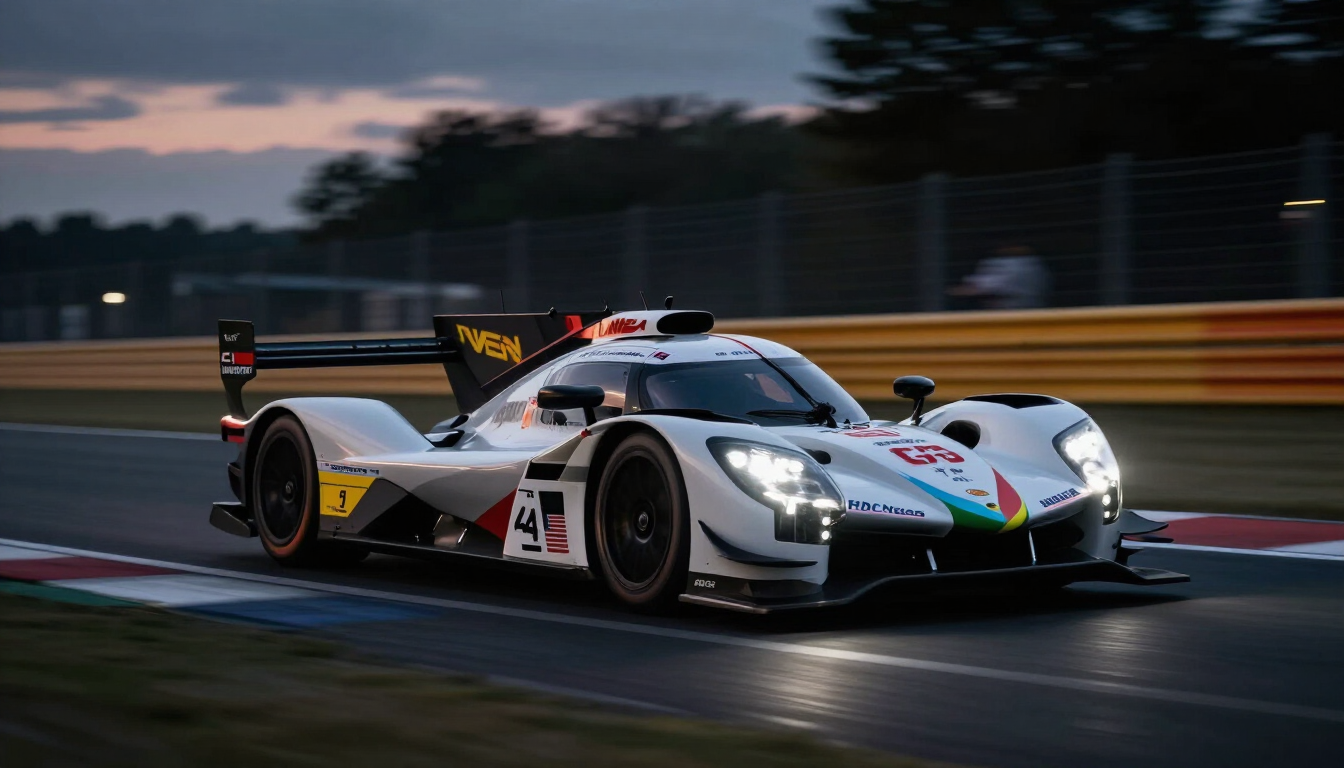
Shooting endurance racing at night requires a different set of technical decisions than any other form of motorsport photography. This is how it works.
The technical challenge of WEC night photography is not the darkness, modern sensors handle low light conditions that would have been impossible a generation ago. The challenge is the light itself: the combination of headlight beams from the cars, the circuit floodlights, the ambient glow from the pit lane, and the occasional flash of sparks from kerb contact creates a dynamic range that no single exposure setting can resolve.
Long exposures are the tool. A half second to a full second in a corner with a dark background produces the light trail that defines the iconic WEC night image, headlights drawing arcs through the frame, the car itself a blur of purpose and speed. The technical requirement is a tripod position that is close enough to the circuit to see the car clearly but far enough back that the full light trail develops within the frame.
The challenge with long exposures is focus. An autofocus system that tracks the car will also track the light trail, which is not a point object and confuses predictive AF algorithms. The photographers who produce the best WEC night images tend to use manual focus set to a predetermined point on the track surface, triggering the exposure when the car passes through that zone. It takes a hundred frames to produce five usable images. The reject rate is normal and expected.
The other technical variable is the direction of the light. A car photographed with its headlights facing the camera produces flare. A car photographed from the side produces the light trail with the car silhouetted against it, a cleaner and more dramatic image. The best WEC night positions are those where the circuit geometry allows a three quarter angle from behind, so the headlights illuminate the corner ahead while the car itself is caught in the ambient circuit light.
It is technical, deliberate, and physical, a night in a corner position with a heavy camera bag, watching the same corner for six hours and making small adjustments to the exposure and focus position as the circuit's ambient light level changes with the hour. The best night images from Le Mans look effortless. They were not.
The 2026 FIA World Endurance Championship standings capture the state of play recorded After Round 5, 6 Hours of São Paulo. René Rast / Robin Frijns leads the drivers classification on 75 points, level with Kobayashi / Conway / de Vries on 75, with Sheldon van der Linde third on 65. With the top two level on points, the championship is effectively open at the top, and the rounds still to run will decide it entirely. The championship will be settled by how the front runners negotiate the rounds that remain, not by the margin they carry into them.
Behind the leading group the field is tightly compressed. Pier Guidi / Giovinazzi / Calado holds fourth on 57, Hartley / Hirakawa / Buemi is fifth on 56, and Magnussen / Marciello completes the top six on 50. The spread across those three positions is just 7 points, which means a single strong weekend can reshape the order behind the title contenders. The midfield battle is where the championship depth is most visible, and where the cost of one bad round is highest.
In the teams classification, BMW M Team WRT leads on 190 points from Toyota Gazoo Racing on 131 and Ferrari AF Corse on 117. The teams standings are often the more reliable indicator of outright pace, because they smooth out the individual bad weekends that every driver encounters across a full season. A team that places both its entries consistently in the points will accumulate constructors score at a rate that single car brilliance cannot match.
The depth of the teams championship reflects how competitive the FIA WEC grid has become. BMW M Team WRT holds the lead on 190 points, but the gap to Toyota Gazoo Racing on 131 is small enough that a single double points finish can close it. Behind them, Ferrari AF Corse sits third on 117, close enough to capitalise if either of the top two stumbles. The constructors race is a long game, and it rewards reliability over heroics.
The recent rounds have done most to shape the current standings. 6 Hours of Spa at Spa Francorchamps, BEL was won by BMW #20, 24 Hours of Le Mans at Circuit de la Sarthe, FRA went the way of Toyota #7, and the most recent completed round, 6 Hours of São Paulo at Interlagos, Brazil, was won by BMW #15. Each of those results shifted the points arithmetic at the top and reset the momentum that the title contenders carry into the next weekend.
The form guide across the recent rounds reads as a study in momentum. BMW #15 took the most recent victory at Interlagos, Brazil, Toyota #7 won at Circuit de la Sarthe, FRA before that, and BMW #20 prevailed at Spa Francorchamps, BEL. No single driver has dominated the recent sequence, which is why the points lead at the top has remained stable rather than stretching. The closing rounds will decide whether that pattern holds or one contender finally strings together the run of results that settles the title.