
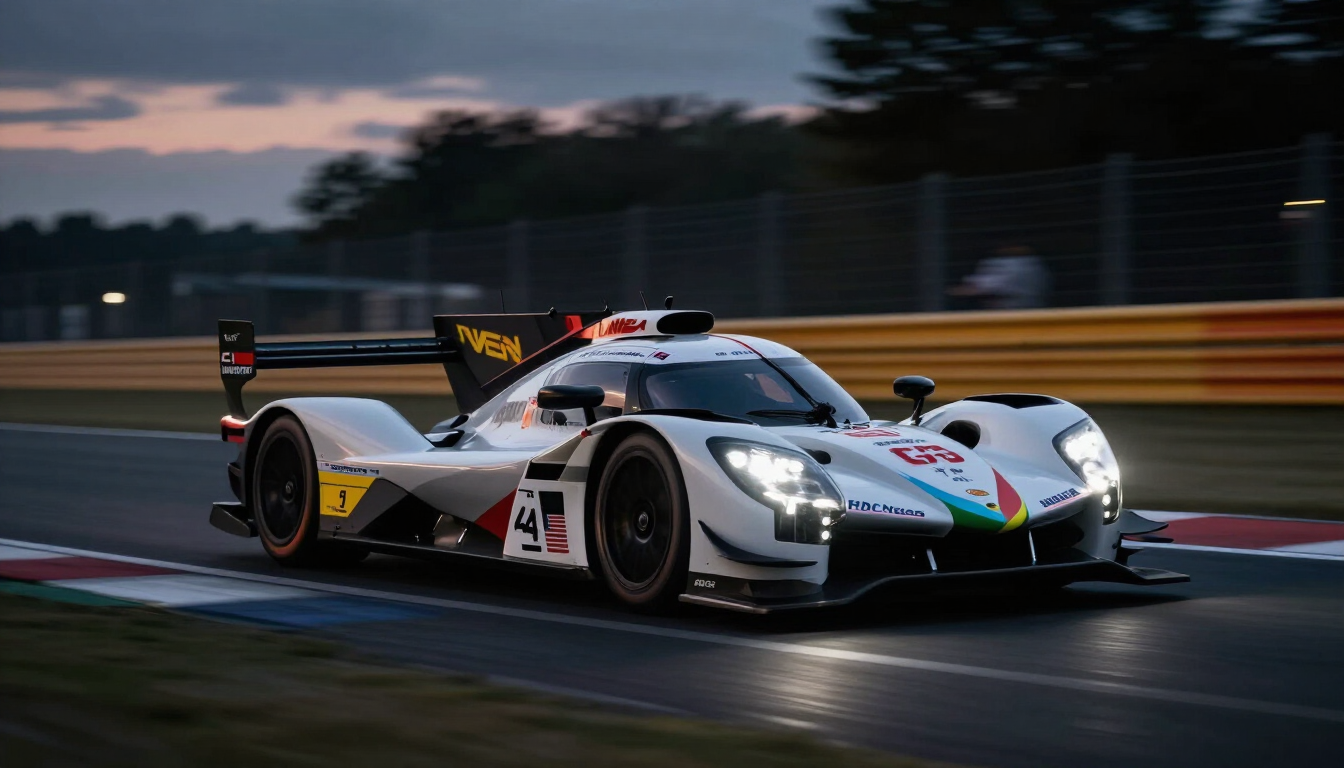
A 24 hour race requires up to forty pit stops. Every one is rehearsed. The rehearsal process is as technical as the race itself.
An endurance racing team begins planning its pit stop sequence approximately two weeks before the race. The planning document that governs the sequence covers fuel loads, tyre compound changes, driver handovers, refuelling durations, and the decision tree for each type of stop. It is updated daily as pre race practice data arrives and revised in real time during the race itself.
The rehearsal programme mirrors this complexity. Hypercar teams run four or five dedicated pit stop practice days in the months before Le Mans, each focussed on a different variable. Early sessions establish the baseline sequence, the clean, no incident stop from which everything else is measured. Later sessions introduce variables: a late driver arrival, an unexpected under tyre problem, a windscreen wipe request mid stop.
The driver handover is the most complex element. Unlike single seater racing, an endurance stop may require the car to be stationary for ninety seconds or more, during which the outgoing driver must exit, the incoming driver must enter, the belts must be adjusted, the mirrors set, and a systems check completed. Teams rehearse this to a second level precision: the incoming driver must be standing at the rear of the car before it enters the pit box, not approaching from the side.
Fuel is the other major rehearsal component. Endurance refuelling requires exact fuel loads matched to the stint plan, and the flow rate and pressure of the rig must be verified before every session. A rig failure mid race is one of the few scenarios that a team cannot recover from gracefully, the time penalty of a second trip to the garage is too large. Teams maintain backup rigs and practice the changeover.
The drivers tend to underestimate the rehearsal value until they have experienced a race where something goes wrong. At that point, the muscle memory built in testing, the exact body position for the entry, the sequence of switch movements before the engine is restarted, the moment to look left for the lollipop, becomes the difference between recovering a situation and losing a position. Twenty four hours is long enough for everything to go wrong once. Good rehearsal means it only goes wrong once.
The 2026 FIA World Endurance Championship standings capture the state of play recorded After Round 5, 6 Hours of São Paulo. René Rast / Robin Frijns leads the drivers classification on 75 points, level with Kobayashi / Conway / de Vries on 75, with Sheldon van der Linde third on 65. With the top two level on points, the championship is effectively open at the top, and the rounds still to run will decide it entirely. The championship will be settled by how the front runners negotiate the rounds that remain, not by the margin they carry into them.
Behind the leading group the field is tightly compressed. Pier Guidi / Giovinazzi / Calado holds fourth on 57, Hartley / Hirakawa / Buemi is fifth on 56, and Magnussen / Marciello completes the top six on 50. The spread across those three positions is just 7 points, which means a single strong weekend can reshape the order behind the title contenders. The midfield battle is where the championship depth is most visible, and where the cost of one bad round is highest.
In the teams classification, BMW M Team WRT leads on 190 points from Toyota Gazoo Racing on 131 and Ferrari AF Corse on 117. The teams standings are often the more reliable indicator of outright pace, because they smooth out the individual bad weekends that every driver encounters across a full season. A team that places both its entries consistently in the points will accumulate constructors score at a rate that single car brilliance cannot match.
The depth of the teams championship reflects how competitive the FIA WEC grid has become. BMW M Team WRT holds the lead on 190 points, but the gap to Toyota Gazoo Racing on 131 is small enough that a single double points finish can close it. Behind them, Ferrari AF Corse sits third on 117, close enough to capitalise if either of the top two stumbles. The constructors race is a long game, and it rewards reliability over heroics.
The recent rounds have done most to shape the current standings. 6 Hours of Spa at Spa Francorchamps, BEL was won by BMW #20, 24 Hours of Le Mans at Circuit de la Sarthe, FRA went the way of Toyota #7, and the most recent completed round, 6 Hours of São Paulo at Interlagos, Brazil, was won by BMW #15. Each of those results shifted the points arithmetic at the top and reset the momentum that the title contenders carry into the next weekend.
The form guide across the recent rounds reads as a study in momentum. BMW #15 took the most recent victory at Interlagos, Brazil, Toyota #7 won at Circuit de la Sarthe, FRA before that, and BMW #20 prevailed at Spa Francorchamps, BEL. No single driver has dominated the recent sequence, which is why the points lead at the top has remained stable rather than stretching. The closing rounds will decide whether that pattern holds or one contender finally strings together the run of results that settles the title.
The next round is Lone Star Le Mans at COTA, Austin TX, scheduled for 4, 6 Sep. It is round 6 of the season and the first of the closing stretch. How the championship leader handles the specific technical demands of COTA, Austin TX will indicate whether the current margin is a foundation to build on or a high water mark that the chasing group can erode. Every remaining weekend now carries championship weight.