
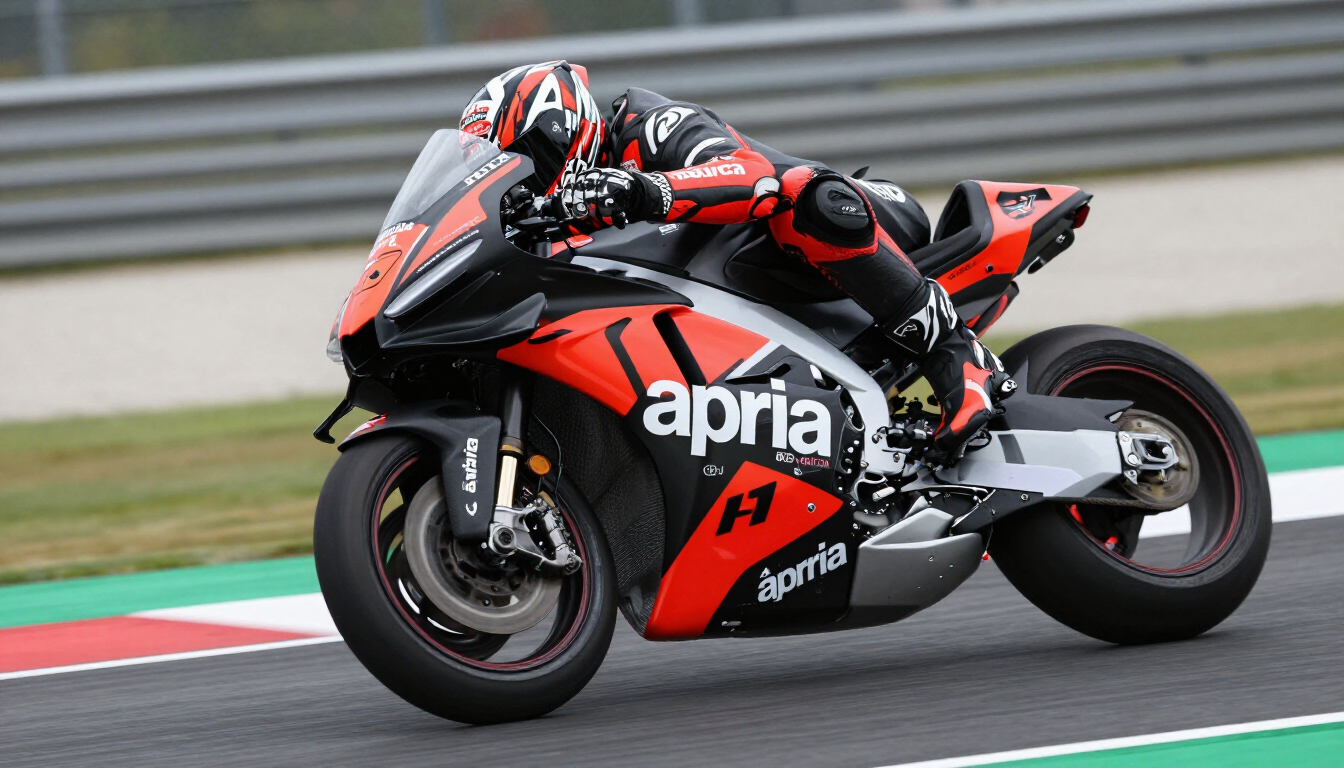
Jorge Martín leads the 2026 MotoGP World Championship by eighteen points from Marc Márquez. Behind them, Ai Ogura and Marco Bezzecchi are close enough to win it all. With eleven rounds remaining and five different circuits that suit five different bikes, this is the most open title fight in a decade.
Eleven rounds into the 2026 MotoGP World Championship, the standings sheet tells you almost nothing about how this season will end. Jorge Martín holds the top position with 208 points. Ai Ogura is second with 194, fourteen points behind. Marc Márquez sits third on 190, and Marco Bezzecchi is fourth with 187. Twenty one points separate first from fourth place. The mathematics favour the leader. The racing tends to complicate the mathematics.
This is the championship scenario that the sport's broadcasters dream about and its title contenders dread. Four genuine winners, four different motorcycle philosophies, and a calendar that shifts advantage every fortnight. The second half of the 2026 season spans eleven rounds across four continents. At some of those circuits, Martín's Aprilia RS GP26 will be the fastest machine. At others, Márquez's Ducati Desmosedici GP26 will be faster. The variable that no wind tunnel can predict is the one every experienced paddock observer mentions first: who makes the fewest errors when the pressure is highest.
Martín's strength as champion has never been raw pace. His Sachsenring qualifying lap was the fourth fastest in the field. He started the German Grand Prix from the second row. He finished fifth. And yet he still leads the championship. The defending champion's title in 2025 was built not on dominant weekends but on an astonishing consistency, a refusal to finish outside the top six across a seventeen round sequence that included two crashes for Márquez and a mechanical retirement for Bezzecchi. Martín did not win the title last year. His rivals conceded it to him.
The 2026 version of Martín is, by his own assessment, a more complete rider. His corner entry technique, historically his weakness on the RS GP26, has improved measurably since the start of the season. Aprilia's engineers spent the winter refining the bike's front end behaviour specifically to suit Martín's preferred braking reference points. The result is a rider who, for the first time in his career, is comfortable running at the front rather than managing from behind. He is yet to win a race this season, but his relentless top five consistency has kept him at the head of the standings even as Márquez, Bezzecchi and Ogura have traded victories.
Márquez, meanwhile, is the reason the championship is a fight at all. After his Sachsenring win extended his German Grand Prix record to an almost supernatural twelve victories, the seven time world champion has accumulated three race wins and eight further podiums from eleven starts, a conversion rate that, for any other rider on the grid, would represent the season of their career. For Márquez, it is almost ordinary. The question is not whether he can win the championship. It is whether the Ducati GP26 gives him the tools to do it across the full calendar.
The Ducati advantage is well understood. On circuits that reward hard braking into tight corners and aggressive acceleration out of them, Phillip Island, Motegi, Valencia, the GP26 is several tenths per lap faster than the Aprilia in outright performance. Márquez exploits this advantage more than any other Ducati rider because his riding style amplifies the bike's natural tendencies: he is late, committed, and precise under braking in a way that extracts performance other riders cannot access.
But there is a counter argument, and it lives in Aprilia's data. The second half of the calendar also features Misano, where the RS GP26 won last year. It features Aragon, where Martín has won twice in three seasons. And it features the Australian Grand Prix at Phillip Island, where the Ducati is usually fastest but where the 2026 calendar has moved the race to October, a period when the circuit's notoriously difficult wind conditions have historically levelled the machinery gap.
Ogura is the dimension the pre season analysis missed entirely. The 24 year old Japanese rider arrived at Trackhouse Aprilia without a single MotoGP race start to his name. The assumption in the paddock was that a rookie season, even a gifted rookie on good machinery, would produce inconsistency, errors, and a learning curve visible from the grandstands. Ogura's learning curve has been invisible. He has finished outside the top six once in eleven races, and that was a mechanical failure that took him out of a position to challenge for victory.
His riding data is unusual. His pace on used tyres is higher relative to the race leader than any other rider in the field. Where most grand prix riders lose approximately 0.8 seconds per lap across a 27 lap race as tyre performance degrades, Ogura's pace drops less than half that amount. Aprilia's tyre engineers believe this reflects an unusually light throttle style that reduces rear tyre heat generation, a natural characteristic that cannot be coached, only found.
The championship fight's final uncertainty is Bezzecchi, and it is the most difficult to quantify. The Italian's four race victories have all come in circumstances that suited his specific strengths: high speed technical circuits where the Aprilia's cornering stability translates into lap time advantages invisible in sector analysis. His weakness, and he acknowledges it freely, is the same circuits that favour Márquez's Ducati. If the second half of the season delivers three or four Ducati circuit rounds in sequence, Bezzecchi's mathematical chance of the title will become theoretical rather than real.
What makes the 2026 championship historically unusual is not just the points compression. It is the quality of all four contenders. Previous close championships have often featured a dominant rider temporarily checked by misfortune and a challenger seizing a window. This one features four riders who, on the right circuit on the right weekend, are all the fastest person on the planet on a motorcycle. None of them is carrying misfortune as their primary talking point. All of them are performing near or at their capability ceiling.
Eleven rounds remain. The next is Silverstone, the British Grand Prix and a fast, flowing circuit that traditionally favours the Ducati's braking strength. After that, the series travels to Aragon, Misano, Austria, Japan, Indonesia, Australia, Malaysia, Qatar, Portugal, and concludes in Valencia. The calendar does not hand the championship to any single manufacturer. It asks every rider to be competitive everywhere.
Martín leads. Márquez hunts. Ogura waits. Bezzecchi believes. Fourteen cover the top two. Twenty one cover the top four. Eleven rounds and a world championship: the only thing certain is that nothing is certain.
The 2026 MotoGP World Championship standings capture the state of play recorded After Round 11, German Grand Prix (Sachsenring). Jorge Martín leads the riders classification on 208 points, 14 clear of Ai Ogura on 194, with Marc Márquez third on 190. A lead of 14 points is a meaningful cushion at this stage of the year, but with 11 rounds still to run it is not yet a decisive one. The championship will be settled by how the front runners negotiate the rounds that remain, not by the margin they carry into them.
Behind the leading group the field is tightly compressed. Marco Bezzecchi holds fourth on 187, Fabio Di Giannantonio is fifth on 184, and Raúl Fernández completes the top six on 159. The spread across those three positions is just 28 points, which means a single strong weekend can reshape the order behind the title contenders. The midfield battle is where the championship depth is most visible, and where the cost of one bad round is highest.
In the teams classification, Aprilia Racing leads on 395 points from SuperFile Trackhouse MotoGP on 353 and Ducati Lenovo Team on 333. The teams standings are often the more reliable indicator of outright pace, because they smooth out the individual bad weekends that every rider encounters across a full season. A team that places both its entries consistently in the points will accumulate constructors score at a rate that single car brilliance cannot match.
The depth of the teams championship reflects how competitive the MotoGP grid has become. Aprilia Racing holds the lead on 395 points, but the gap to SuperFile Trackhouse MotoGP on 353 is small enough that a single double points finish can close it. Behind them, Ducati Lenovo Team sits third on 333, close enough to capitalise if either of the top two stumbles. The constructors race is a long game, and it rewards reliability over heroics.
Among the manufacturers, Aprilia leads on 748 points from Ducati on 726, with KTM third on 298. The manufacturer standings capture the underlying technical balance of the championship and track which factory has the strongest package across the widest range of circuits. The gap between the top two factories is the clearest measure of how close the technical battle really is.
The recent rounds have done most to shape the current standings. Czech Republic Grand Prix at Automotodrom Brno was won by Bagnaia, Dutch TT at TT Circuit Assen went the way of Ogura, and the most recent completed round, German Grand Prix at Sachsenring, was won by Marc Márquez. Each of those results shifted the points arithmetic at the top and reset the momentum that the title contenders carry into the next weekend.
The form guide across the recent rounds reads as a study in momentum. Marc Márquez took the most recent victory at Sachsenring, Ogura won at TT Circuit Assen before that, and Bagnaia prevailed at Automotodrom Brno. No single rider has dominated the recent sequence, which is why the points lead at the top has remained stable rather than stretching. The closing rounds will decide whether that pattern holds or one contender finally strings together the run of results that settles the title.
The next round is British Grand Prix at Silverstone Circuit, scheduled for 22, 24 Aug. It is round 12 of the season and the first of the closing stretch. How the championship leader handles the specific technical demands of Silverstone Circuit will indicate whether the current margin is a foundation to build on or a high water mark that the chasing group can erode. Every remaining weekend now carries championship weight.
The 2026 MotoGP World Championship calendar runs to 22 rounds. So far 11 rounds are complete, leaving 11 to decide the title. Across the completed rounds the championship has tested its contenders on a range of layouts, surfaces and conditions, and the standings reflect which rider has coped with that variety most consistently. The rounds still to come will ask different questions, and the answers will determine the champion.
The points structure means a maximum weekend is worth substantially more than the current lead at the top. With 14 points separating first from second and 11 rounds remaining, the leader can absorb an off weekend and still retain position, provided the closest rival does not take maximum score. That arithmetic shapes how the front runners approach risk in the closing rounds, where a conservative finish can be worth more than a speculative win.
The competitive spread at the front is narrow. The top three are covered by 18 points and the top six by 49. In a field this close, consistency is proving more valuable than outright speed, and the championship is trending towards the contender who minimises the bad weekends rather than the one who maximises the good ones. The margin between a title and a near miss is measured in finishes, not victories.