
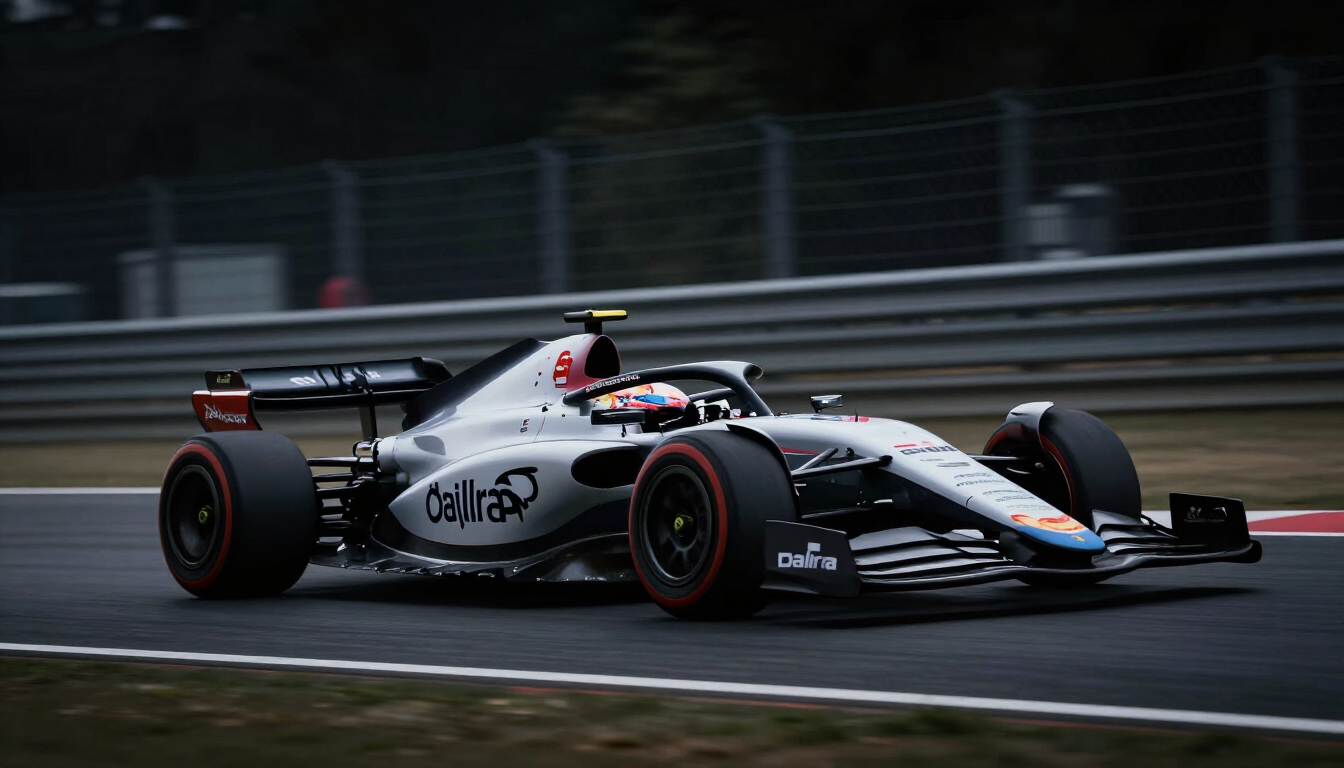
The F2 car is a spec chassis. Every team runs the same hardware. The performance gaps are still significant. Here is where they come from.
A one make formula is supposed to eliminate car performance as a variable. In practice, it eliminates most car performance variables while amplifying the remaining ones. The F2 field runs identical chassis, identical engines, and a mandated tyre supplier. The setup parameters available are limited: wing angles, differential settings, brake bias, and ride height within a defined range. The fastest teams in the field are typically separated from the slowest by approximately eight to twelve tenths of a second per lap. That gap does not come from the car. It comes from how the car is set up and how it is driven.
Wing angle is the most consequential setup parameter in F2. The regulation range is wider than most drivers prefer, and the optimal setting varies significantly by circuit. At Monza, minimum wing produces the fastest lap time but requires the driver to manage understeer throughout the lap. At Monaco, maximum wing is the baseline, and the fastest lap comes from the driver who can exploit the mechanical grip available at the front axle. Getting wing angle right is not about following a default, it is about understanding the specific circuit's sensitivity to front rear aero balance.
Differential settings are the second most diagnostic parameter. The degree of locking on traction affects the car's behaviour on exit from slow corners, and different drivers prefer different balance profiles. A driver who brakes late and carries speed into the corner prefers a more open differential at traction. A driver who trails the brake and builds speed on the exit of the corner prefers a tighter lock. The engineers who get this right are the ones whose drivers describe the car as responsive rather than stable, a distinction that matters more as the season progresses and the driver develops confidence in the balance.
Ride height within the regulation band has the least obvious effect but the most measurable one in long run data. Running the car slightly higher than minimum reduces the aerodynamic sensitivity to track surface variation, which matters at circuits with surface degradation across the race distance. Teams that chase minimum ride height for peak lap time sometimes find their race pace compromised on surfaces that develop bumps across the session.
The setup argument in a one make series is never about the car being faster. It is about the car being better matched to this driver, on this circuit, in these conditions. The teams that win championships are the ones who can calibrate that match most precisely, and whose engineers are confident enough to move the car in a direction the driver is initially uncomfortable with if the data supports it.
The 2026 FIA Formula 2 Championship standings capture the state of play recorded After Round 9, Budapest. Nikola Tsolov leads the drivers classification on 167 points, 20 clear of Gabriele Minì on 147, with Rafael Câmara third on 145. A lead of 20 points is a meaningful cushion at this stage of the year, but with 5 rounds still to run it is not yet a decisive one. The championship will be settled by how the front runners negotiate the rounds that remain, not by the margin they carry into them.
Behind the leading group the field is tightly compressed. Alexander Dunne holds fourth on 108, Noel León is fifth on 94, and Kush Maini completes the top six on 88. The spread across those three positions is just 20 points, which means a single strong weekend can reshape the order behind the title contenders. The midfield battle is where the championship depth is most visible, and where the cost of one bad round is highest.
In the teams classification, Campos Racing leads on 261 points from Invicta Racing on 187 and MP Motorsport on 176. The teams standings are often the more reliable indicator of outright pace, because they smooth out the individual bad weekends that every driver encounters across a full season. A team that places both its entries consistently in the points will accumulate constructors score at a rate that single car brilliance cannot match.
The depth of the teams championship reflects how competitive the Formula 2 grid has become. Campos Racing holds the lead on 261 points, but the gap to Invicta Racing on 187 is small enough that a single double points finish can close it. Behind them, MP Motorsport sits third on 176, close enough to capitalise if either of the top two stumbles. The constructors race is a long game, and it rewards reliability over heroics.
The recent rounds have done most to shape the current standings. Silverstone at Silverstone, Great Britain was won by Bennett / Tsolov, Spa Francorchamps at Spa Francorchamps, Belgium went the way of Tsolov / León, and the most recent completed round, Budapest at Hungaroring, Hungary, was won by Maini / Câmara. Each of those results shifted the points arithmetic at the top and reset the momentum that the title contenders carry into the next weekend.
The form guide across the recent rounds reads as a study in momentum. Maini / Câmara took the most recent victory at Hungaroring, Hungary, Tsolov / León won at Spa Francorchamps, Belgium before that, and Bennett / Tsolov prevailed at Silverstone, Great Britain. No single driver has dominated the recent sequence, which is why the points lead at the top has remained stable rather than stretching. The closing rounds will decide whether that pattern holds or one contender finally strings together the run of results that settles the title.