Cross country rallying is navigation as much as speed, and the current championship leader has built an advantage on the days when the roadbook mattered more than the throttle.
A rally raid stage can be hundreds of kilometres long with no defined route, only a series of waypoints and a roadbook read at speed by a co driver over rough terrain. Losing ten minutes to a navigation error is routine; losing an hour is not unusual. Pure speed is worth far less than it appears.
The Silk Way Rally win reflected that. The stage times show a driver who was rarely the outright fastest but who was never outside the top five, and who did not lose a single significant block of time to a missed waypoint across the whole event. In cross country terms that is the equivalent of a clean sweep.
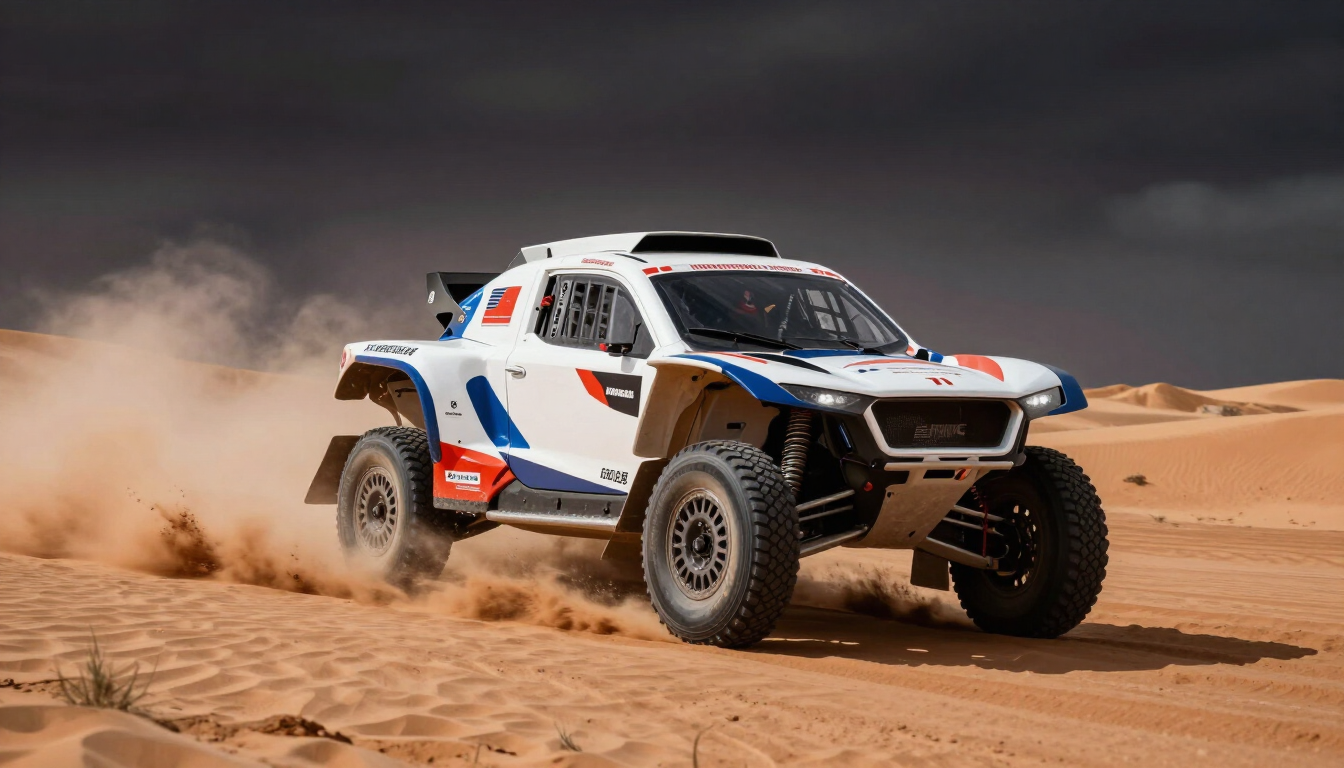
The Toyota Hilux package has been part of it. The car is not the fastest in a straight line across open desert, but it is exceptionally durable over compression damage, which is what ends most rally raid campaigns. Suspension failures and punctures decide these events far more often than a lack of horsepower.
Managing tyres over desert terrain is its own discipline. Teams carry a limited allocation of spares, and a driver who cuts a sidewall on a rock in the first two hundred kilometres of a stage will spend the rest of the day driving to protect what is left rather than racing.
With the championship at this stage, the remaining rounds are about attrition arithmetic. A finish is worth more than a stage win, and the leader can afford to let rivals take the risks that the open desert eventually punishes.
The 2026 FIA World Rally Raid Championship (W2RC) standings capture the state of play recorded After Round 5, Silk Way Rally. Nasser Al Attiyah leads the drivers classification on 210 points, 18 clear of Carlos Sainz on 192, with Sébastien Loeb third on 178. A lead of 18 points is a meaningful cushion at this stage of the year, but with 1 rounds still to run it is not yet a decisive one. The championship will be settled by how the front runners negotiate the rounds that remain, not by the margin they carry into them.
Behind the leading group the field is tightly compressed. Yazeed Al Rajhi holds fourth on 154, Mathieu Serradori is fifth on 131, and Orlando Terranova completes the top six on 118. The spread across those three positions is just 36 points, which means a single strong weekend can reshape the order behind the title contenders. The midfield battle is where the championship depth is most visible, and where the cost of one bad round is highest.
In the teams classification, Toyota GAZOO Racing leads on 364 points from Ford Performance on 192 and BRX Bahrain Raid Xtreme on 296. The teams standings are often the more reliable indicator of outright pace, because they smooth out the individual bad weekends that every driver encounters across a full season. A team that places both its entries consistently in the points will accumulate constructors score at a rate that single car brilliance cannot match.
The depth of the teams championship reflects how competitive the World Rally Raid Championship grid has become. Toyota GAZOO Racing holds the lead on 364 points, but the gap to Ford Performance on 192 is small enough that a single double points finish can close it. Behind them, BRX Bahrain Raid Xtreme sits third on 296, close enough to capitalise if either of the top two stumbles. The constructors race is a long game, and it rewards reliability over heroics.
The recent rounds have done most to shape the current standings. Sonora Rally at Sonora Desert, Mexico was won by Al Attiyah, Rallye du Maroc at Erfoud, Morocco went the way of Loeb, and the most recent completed round, Silk Way Rally at Russia / Mongolia / China, was won by Al Attiyah. Each of those results shifted the points arithmetic at the top and reset the momentum that the title contenders carry into the next weekend.