
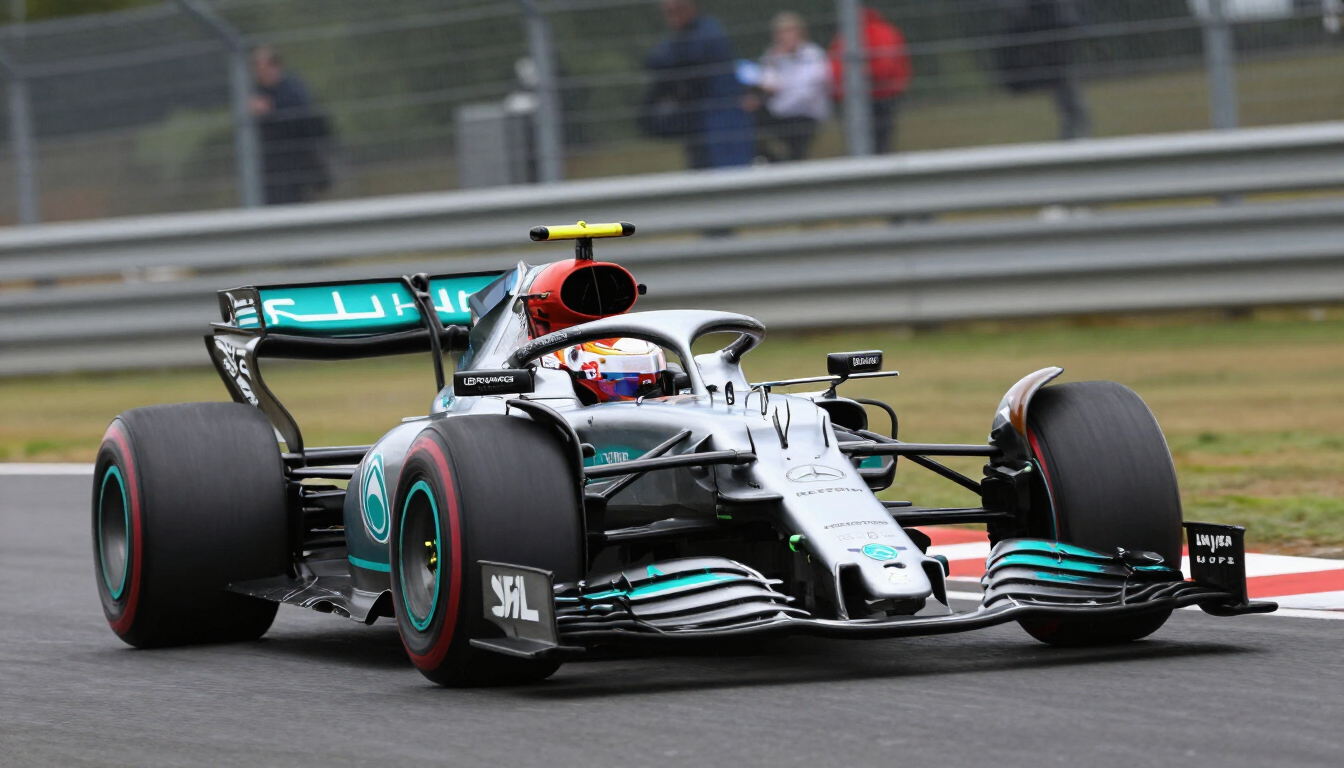
George Russell won the first race of the 2026 season in Melbourne and added a second victory in Austria. Third in the championship behind his teammate Kimi Antonelli, his consistency has been the backbone of Mercedes' constructors' charge.
George Russell arrived in Melbourne for the opening round of the 2026 Formula 1 season with a point to prove, and he proved it immediately. From the front of the field he controlled the Australian Grand Prix to take the first victory of the new campaign, the third season in succession in which he has stood on the top step of the podium. It was the ideal way to answer the questions that had followed him through the winter about where he sat in Mercedes' pecking order.
That opening win set the tone for a strong first half. Russell has been a model of consistency across the eleven rounds completed so far, scoring points in every race he has finished and converting competitive qualifying performances into solid Sunday results. His second victory of the season came at round eight in Austria, where he again managed the race from the front to claim a composed Spielberg win. With 160 points he sits third in the Drivers' Championship at the summer break, behind only his teammate Kimi Antonelli and Ferrari's Lewis Hamilton.
The dynamic inside the Mercedes garage has been one of the stories of the season. Antonelli, in only his second year, has taken the championship by the scruff of the neck with five consecutive wins between rounds two and six, but Russell has been the steadying hand alongside the 19 year old's fireworks. Where Antonelli's season has been defined by outright pace and a remarkable run of victories, Russell's has been built on reliability, racecraft, and the kind of measured Sunday management that keeps a constructors' campaign on the rails.
The numbers underline his value to the team. Mercedes leads the Constructors' Championship with 379 points, 72 clear of Ferrari, and Russell's 160 points represent more than 40 per cent of that total. His finishing record, points in every race he has seen the chequered flag, has given the team the platform from which Antonelli's wins have been able to build such a commanding lead. In a championship where every position matters for the prize fund, that consistency is worth as much as the headline victories.
The second half of the season presents a different challenge. Russell is 59 points behind his teammate with twelve rounds remaining, a gap that is not insurmountable but which would require both a surge in his own results and a dip in Antonelli's remarkable form. The more realistic target is consolidating his hold on third in the standings, fending off Charles Leclerc and Lando Norris, and securing Mercedes' first constructors' title since 2021. If the opening eleven rounds are any guide, Russell is exactly the kind of reliable, race winning presence a championship team needs alongside its rising star.
The 2026 Formula 1 World Championship standings capture the state of play recorded After Round 11, Hungarian Grand Prix. Kimi Antonelli leads the drivers classification on 219 points, 50 clear of Lewis Hamilton on 169, with George Russell third on 160. A lead of 50 points is a meaningful cushion at this stage of the year, but with 12 rounds still to run it is not yet a decisive one. The championship will be settled by how the front runners negotiate the rounds that remain, not by the margin they carry into them.
Behind the leading group the field is tightly compressed. Charles Leclerc holds fourth on 138, Lando Norris is fifth on 128, and Max Verstappen completes the top six on 109. The spread across those three positions is just 29 points, which means a single strong weekend can reshape the order behind the title contenders. The midfield battle is where the championship depth is most visible, and where the cost of one bad round is highest.
In the teams classification, Mercedes leads on 468 points from Ferrari on 346 and McLaren on 287. The teams standings are often the more reliable indicator of outright pace, because they smooth out the individual bad weekends that every driver encounters across a full season. A team that places both its entries consistently in the points will accumulate constructors score at a rate that single car brilliance cannot match.
The depth of the teams championship reflects how competitive the Formula 1 grid has become. Mercedes holds the lead on 468 points, but the gap to Ferrari on 346 is still the clearest constructors story of the season. Behind them, McLaren sits third on 287, with Red Bull Racing fourth on 204. The constructors race is a long game, and it rewards reliability over heroics.
The recent rounds have done most to shape the current standings. British Grand Prix at Silverstone was won by Leclerc, Belgian Grand Prix at Spa Francorchamps went the way of Antonelli, and the most recent completed round, Hungarian Grand Prix at Budapest, was won by Norris. Each of those results shifted the points arithmetic at the top and reset the momentum that the title contenders carry into the next weekend.
The form guide across the recent rounds reads as a study in momentum. Norris took the most recent victory at Budapest, Antonelli won at Spa Francorchamps before that, and Leclerc prevailed at Silverstone. No single driver has dominated the recent sequence, which is why the points lead at the top has remained stable rather than stretching. The closing rounds will decide whether that pattern holds or one contender finally strings together the run of results that settles the title.
The next round is Dutch Grand Prix at Zandvoort, scheduled for 21, 23 Aug. It is round 12 of the season and the first of the closing stretch. How the championship leader handles the specific technical demands of Zandvoort will indicate whether the current margin is a foundation to build on or a high water mark that the chasing group can erode. Every remaining weekend now carries championship weight.
The 2026 Formula 1 World Championship calendar runs to 23 rounds. So far 11 rounds are complete, leaving 12 to decide the title. Across the completed rounds the championship has tested its contenders on a range of layouts, surfaces and conditions, and the standings reflect which driver has coped with that variety most consistently. The rounds still to come will ask different questions, and the answers will determine the champion.