
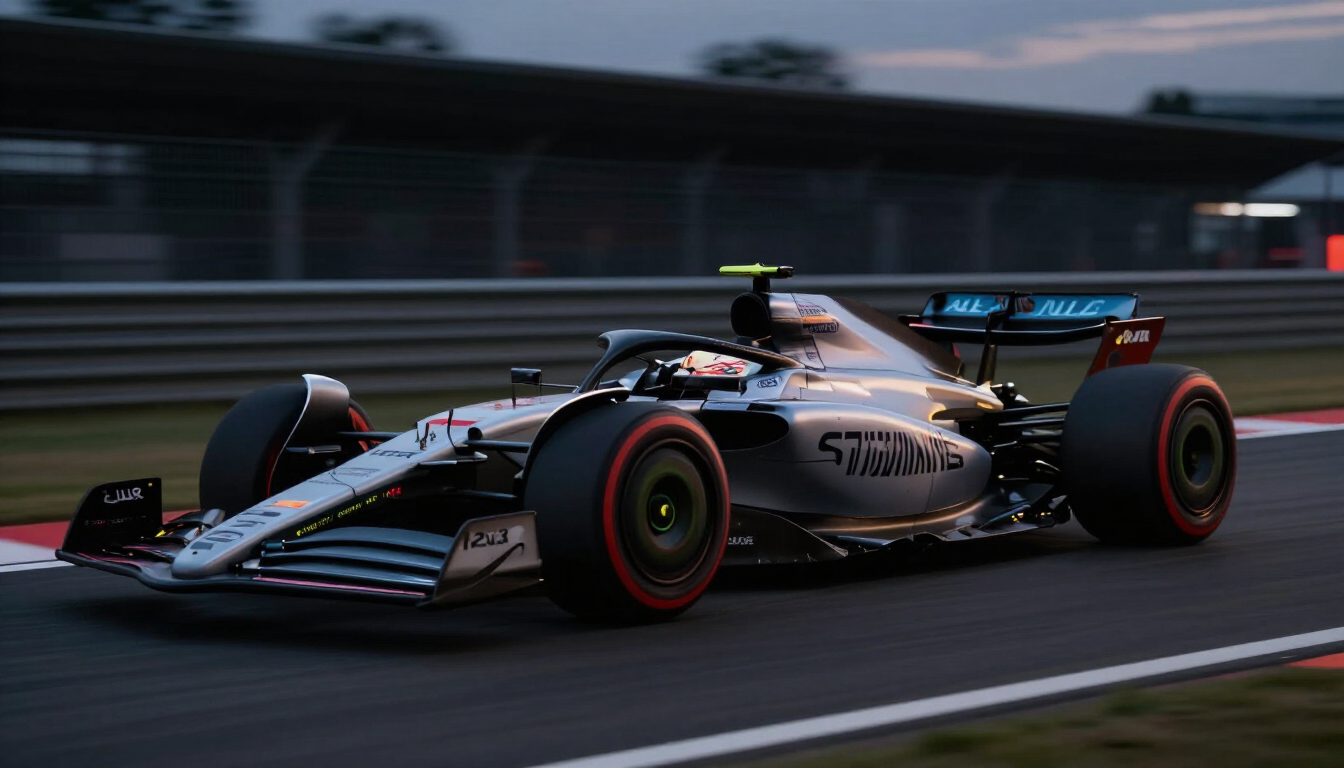
Every qualifying session ends with the last lap on the cleanest circuit surface. Understanding why, and by how much, is where the real preparation happens.
Track evolution is the process by which a circuit surface becomes faster over the course of a session as rubber accumulates on the racing line. It is well understood in principle and systematically underestimated in practice by every team except the one that times their final Q3 run correctly.
The magnitude of track evolution varies by circuit. High abrasion surfaces, tracks that wear tyres quickly, lay down rubber faster and produce larger time deltas between the first and last runs. Low abrasion circuits evolve more slowly. The difference between a first run Q3 time and a last run Q3 time at a high evolution circuit can exceed seven tenths of a second on the same car in the same conditions.
Wind direction is the confounding variable. A track that is evolving quickly also becomes more sensitive to wind changes, because the rubber on the surface interacts differently with airflow. A sudden crosswind in the final minutes of qualifying disrupts the tyre thermal balance and can produce unexpected balance changes at the front of the car. Two teams with identical car performance can end up half a second apart in Q3 simply through the timing of their runs relative to a wind shift.
The teams that manage qualifying best are not always the ones with the fastest cars in race trim. They are the ones with the most accurate evolution model, the ones who know when the track will be at its fastest and can put their car on circuit at exactly that moment. Getting this wrong is costly. The lap deletion that moved a driver from fourth to seventh in the most recent qualifying session was a secondary effect: primary cause was a run start time that missed the optimal rubber down window by ninety seconds.
It is the kind of marginal gain that does not make headlines. It makes grid positions.
The 2026 Formula 1 World Championship standings capture the state of play recorded After Round 11, Hungarian Grand Prix. Kimi Antonelli leads the drivers classification on 219 points, 50 clear of Lewis Hamilton on 169, with George Russell third on 160. A lead of 50 points is a meaningful cushion at this stage of the year, but with 12 rounds still to run it is not yet a decisive one. The championship will be settled by how the front runners negotiate the rounds that remain, not by the margin they carry into them.
Behind the leading group the field is tightly compressed. Charles Leclerc holds fourth on 138, Lando Norris is fifth on 128, and Max Verstappen completes the top six on 109. The spread across those three positions is just 29 points, which means a single strong weekend can reshape the order behind the title contenders. The midfield battle is where the championship depth is most visible, and where the cost of one bad round is highest.
In the teams classification, Mercedes leads on 468 points from Ferrari on 346 and McLaren on 287. The teams standings are often the more reliable indicator of outright pace, because they smooth out the individual bad weekends that every driver encounters across a full season. A team that places both its entries consistently in the points will accumulate constructors score at a rate that single car brilliance cannot match.
The depth of the teams championship reflects how competitive the Formula 1 grid has become. Mercedes holds the lead on 468 points, but the gap to Ferrari on 346 is still the clearest constructors story of the season. Behind them, McLaren sits third on 287, with Red Bull Racing fourth on 204. The constructors race is a long game, and it rewards reliability over heroics.
The recent rounds have done most to shape the current standings. British Grand Prix at Silverstone was won by Leclerc, Belgian Grand Prix at Spa Francorchamps went the way of Antonelli, and the most recent completed round, Hungarian Grand Prix at Budapest, was won by Norris. Each of those results shifted the points arithmetic at the top and reset the momentum that the title contenders carry into the next weekend.
The form guide across the recent rounds reads as a study in momentum. Norris took the most recent victory at Budapest, Antonelli won at Spa Francorchamps before that, and Leclerc prevailed at Silverstone. No single driver has dominated the recent sequence, which is why the points lead at the top has remained stable rather than stretching. The closing rounds will decide whether that pattern holds or one contender finally strings together the run of results that settles the title.