
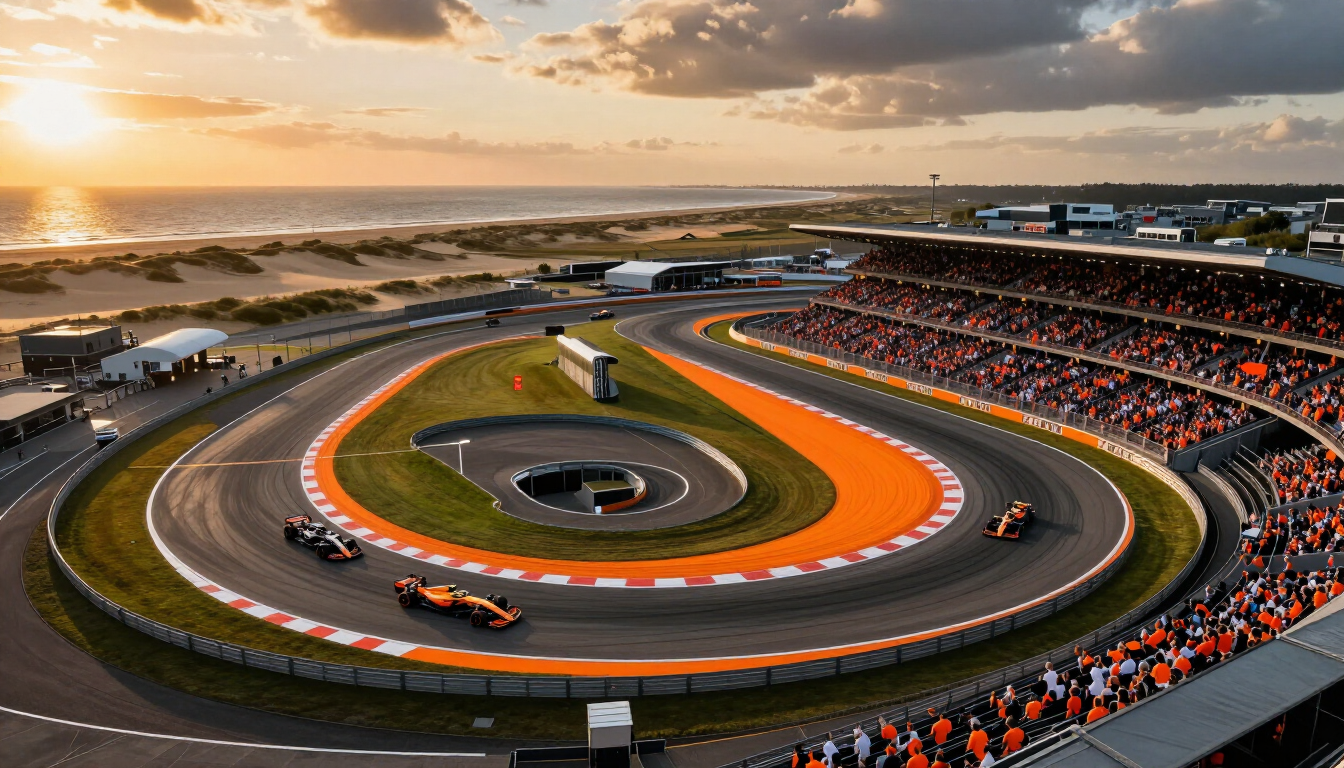
Carved from the North Sea dunes in the shadow of the Second World War, Circuit Zandvoort has hosted Formula 1 across two distinct eras, survived tragedy, financial ruin and a 36-year absence, and now prepares to stage its final scheduled Dutch Grand Prix. This is the complete story of one of motorsport’s most distinctive circuits.
Few circuits in Formula 1 carry a story as long, as fractured and as ultimately redemptive as Zandvoort. Tucked into the sand dunes of the Dutch North Sea coast, it has been a street circuit, a permanent track, a casualty of war, a venue for tragedy, a forgotten relic and, in its modern form, one of the most atmospheric places the championship visits.
Its relationship with Formula 1 stretches across two eras separated by a 36-year void. In 2026, that relationship is scheduled to end. Before the lights go out on what is being marketed as “The Final Lap,” it is worth understanding how a circuit built beside the sea became one of the sport’s most enduring and distinctive venues.
This is the complete history of Circuit Zandvoort, from 1939 to the 2026 finale.
What follows is a circuit biography told in chapters, from the first street race held on temporary roads in 1939, through the post-war construction of the permanent track, the arrival of Formula 1, the tragedies that forced change, the long decades away from the championship, and the remarkable modern revival that turned a nearly forgotten venue into one of the most celebrated stops on the calendar.
Along the way the story touches some of the greatest names the sport has ever produced, the engineering evolution of the layout itself, and the cultural phenomenon of the Orange Army that transformed the Dutch Grand Prix into something closer to a national celebration than a motor race.
Timeline
The evolution of Zandvoort
- 1939First street race held on temporary Zandvoort roads.
- 1948Permanent circuit opens; Prince Bira wins the inaugural race.
- 1952First F1 World Championship Grand Prix; Ascari leads a Ferrari 1, 2, 3.
- 1970sTragedy strikes; major safety changes and chicanes arrive.
- 1985Lauda takes his final F1 victory in the last old-era Dutch GP.
- 1985 to 202136 years away from Formula 1; the circuit survives in other series.
- 2021F1 returns; Verstappen wins before a roaring Orange Army.
- 2026The Final Lap, the last scheduled Dutch Grand Prix at Zandvoort.
1939 to 1948: The beginning
Racing began at Zandvoort in 1939 on a temporary street circuit laid out through the coastal town. The event was a success, and the enthusiasm it generated was enough to convince the local authorities and motorsport figures that a permanent circuit should be built through the surrounding dunes.
Then the Second World War intervened. Work on a permanent facility was halted, and the site, like so much of occupied Europe, was repurposed for the war effort. It was only after the conflict ended that construction resumed and the permanent circuit was completed.
The first race on the new permanent layout was held on 7 August 1948, won by Prince Bira of Siam, the Thai royal and accomplished privateer who was a familiar figure in post-war European racing. From that August afternoon, the circuit’s location among the sand dunes beside the North Sea became its defining characteristic, shaping both its character and the challenges it would present to every generation of driver who followed.
1952: Formula 1 arrives
Zandvoort joined the Formula 1 World Championship calendar in 1952, hosting its first official Grand Prix. Alberto Ascari won the race for Ferrari, leading home a dominant Ferrari 1, 2, 3 that underlined both the Italian team’s superiority in that era and the circuit’s arrival on the sport’s biggest stage.
Over the following decades, the Dutch Grand Prix became a fixture of the championship and a circuit that the sport’s greatest drivers had to master. The list of men who raced, won and suffered at Zandvoort reads like a roll call of Formula 1 royalty: Juan Manuel Fangio, Stirling Moss, Jim Clark, Graham Hill, Jackie Stewart, Jack Brabham, Niki Lauda, Alain Prost and Gilles Villeneuve all tackled the dunes.
Each left their mark. Clark’s precision through the fast sweeps, Villeneuve’s car control on the limit, Lauda’s calculating approach to a circuit that punished mistakes, the track demanded respect and rewarded commitment in equal measure across three decades of the old layout.
1970s: The dangerous era
The original Zandvoort layout was incredibly fast, and as the cars grew quicker still through the late 1960s and 1970s, it became increasingly dangerous. The combination of high speeds, limited run-off and the unforgiving dunes created a circuit where the margin for error was vanishingly small.
In 1970, the dangers were made brutally clear when British driver Piers Courage was killed in a crash during the Dutch Grand Prix. The death of the talented and popular privateer sent shockwaves through the paddock and triggered the first wave of major safety changes at the circuit.
The darkest chapter came in 1973, when Roger Williamson was killed after his March caught fire in a crash. The lack of an effective firefighting response, and the agonising sight of fellow driver David Purley attempting single-handedly to rescue Williamson, became one of the most harrowing moments in Formula 1 history and one of the darkest in Zandvoort’s long story.
Safety improvements continued in the years that followed, with chicanes introduced to break up the circuit’s fearsome top speeds. The track that had been defined by its flat-out commitment was gradually tamed, but the memory of what it had cost never fully left the place.
1985: Lauda’s final victory
The final Formula 1 race of the original Zandvoort era took place on 25 August 1985. It produced a result that gave the occasion a storybook quality: Niki Lauda won the Dutch Grand Prix, beating his McLaren teammate Alain Prost by just 0.232 seconds in a finish that went to the very last lap.
It was Lauda’s 25th and final Formula 1 victory, the last win of one of the sport’s most remarkable careers. That it came at Zandvoort, a circuit he had raced across two stints in the championship, gave the afternoon an added poignancy.
Ayrton Senna finished third, completing a final podium of the old Zandvoort era that reads, in retrospect, like a handover between generations: Lauda, the three-time champion nearing the end; Prost, the dominant force of the moment; and Senna, the genius who would define the years to come. Niki Lauda, Alain Prost, Ayrton Senna. It was a fitting, if unrepeatable, farewell.
1985 to 2021: 36 years away
After that 1985 race, Formula 1 left Zandvoort. The championship moved on, and the circuit was left to confront a future without its headline event.
The years that followed were difficult. Zandvoort faced serious financial problems, and parts of the original facility were redeveloped as the venue struggled to remain viable. For a time, it looked as though the circuit might disappear entirely, another victim of motorsport’s shifting economics.
The track itself, however, survived. It continued to host other forms of motorsport, kept alive by the dedication of local organisers and a loyal Dutch fanbase. For 36 years, there was no Dutch Grand Prix, and an entire generation of Formula 1 fans grew up never seeing the championship race among the dunes.
Then came Max Verstappen.
2021: The Dutch Grand Prix returns
The return of the Dutch Grand Prix had originally been planned for 2020, the culmination of years of effort to bring Formula 1 back to Zandvoort. The COVID-19 pandemic cancelled those plans, delaying the homecoming by a year and leaving the circuit and its supporters waiting still longer.
Formula 1 finally returned on 5 September 2021, 36 years to the month after Lauda’s farewell victory. The modern circuit had been upgraded to meet current F1 requirements while deliberately retaining the traditional character that made Zandvoort unique, including its narrow, flowing layout and the addition of banking at key corners.
Max Verstappen won the race, taking pole position and defeating Lewis Hamilton in a straight fight, with Valtteri Bottas completing the podium. The result mattered, but the atmosphere mattered more. The famous Orange Army surrounded the circuit, turning the dunes into a sea of Dutch orange and producing one of the most spectacular atmospheres Formula 1 had seen in the modern era.
The homecoming was complete. A circuit that had been written off had become, almost overnight, one of the most sought-after tickets on the calendar.
What makes Zandvoort special
The modern Zandvoort layout measures approximately 4.259 kilometres and features 14 corners, making it relatively short by Formula 1 standards. What it lacks in length it more than makes up for in character, with a sequence of corners that have become iconic in their own right.
The Tarzanbocht, the famous first corner, is one of the best overtaking opportunities on the circuit, a heavy braking zone at the end of the main straight where drivers jostle for position on the opening lap. The Scheivlak is a fast, flowing section and one of Zandvoort’s signature corners, rewarding commitment and a well-balanced car.
Two banked corners define the modern circuit. The Hugenholtzbocht is a heavily banked corner that allows drivers to carry remarkable speed through its curved surface, and the Arie Luyendykbocht, the spectacular final corner, uses its steep banking to let drivers maintain huge speed onto the main straight. That banking is one of the things that sets modern Zandvoort apart from almost every other circuit on the Formula 1 calendar.
2026: The finale
The 2026 Dutch Grand Prix is scheduled to be the final Dutch Grand Prix at Zandvoort, an event the organisers have marketed as “The Final Lap.” After the highs of the Verstappen-era homecoming, the circuit and Formula 1 have agreed that 2026 will close this chapter of their long, interrupted relationship.
The finale will feature a Formula 1 Sprint for the first time at Zandvoort, with the scheduled Sprint set at 24 laps. The addition of the Sprint format to a circuit that rewards aggression and rewards a well-set-up car promises to make the farewell weekend a sporting occasion as well as an emotional one.
For a venue that has packed two eras of Formula 1, tragedy, rebirth and a 36-year absence into a single story, the 2026 finale is a chance to say goodbye on its own terms, beside the dunes, in front of the Orange Army, under the lights of a sport that finally came back.
The complete story
From a temporary street race in 1939 to a permanent circuit opened in 1948, from Ascari’s Ferrari dominance in 1952 through the tragedy and safety reckoning of the 1970s, to Lauda’s poignant final win in 1985, the first era of Zandvoort was a complete arc in itself.
Then came the 36-year absence, the financial struggles, the redevelopment and the quiet survival, before Verstappen’s 2021 homecoming reignited the circuit’s place in Formula 1. Now, in 2026, the final scheduled Dutch Grand Prix will close the story.
Few circuits earn the word legendary. Zandvoort, carved from the dunes and carried by the North Sea wind through nine decades of motorsport history, has earned it many times over.